
The following will contain spoilers for Mobile Suit Gundam Hathaway: The Sorcery of Nymph Circe.
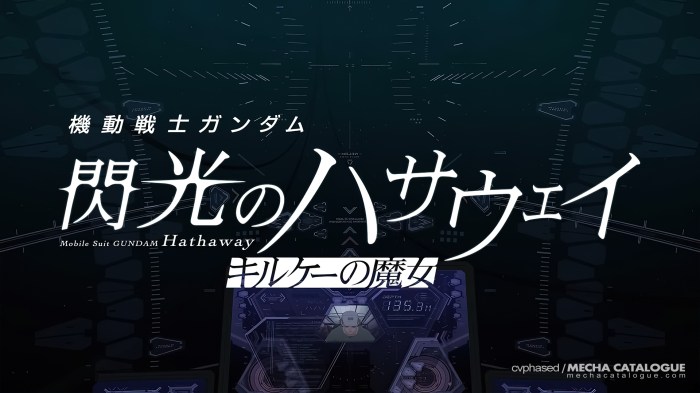
Director / Shukou Murase
Screenplay / Yasuyuki Mutou (based on Yoshiyuki Tomino’s Mobile Suit Gundam: Hathaway’s Flash novels)
Production / Sunrise (Bandai-Namco Filmworks)
Release Date / January 2026
After five years and several delays due to very familiar circumstances, Mobile Suit Gundam Hathaway: The Sorcery of Nymph Circe, the sophomore installment in the Mobile Suit Gundam Hathaway film trilogy, finally had its Japanese theatrical premiere last January. It then took a couple more months before the film received international releases. Based on the second book in the Mobile Suit Gundam: Hathaway’s Flash novel trilogy, the film immediately picks up where the first left off. Hathaway, along with his cohorts in the Anti–Earth Federation group Mafty, head toward the conference in Adelaide. Meanwhile, Kenneth Sleg and his newly rechristened Circe Unit are in hot pursuit, as Lane Aim contemplates his last encounter with Mafty. All the while, the mysterious Gigi Andalucia tags along as their “goddess of luck.”


I haven’t read the source novels, though those who have mention that the film remains largely faithful aside from some creative choices. Scope-wise—and this isn’t a knock against the film if it’s accurate to the source material—I felt it’s rather small as the events mainly cover Mafty’s movement from the southern end of Indonesia into continental Australia. Major developments revolve around Mafty’s meetup and collaboration with the self-proclaimed affiliate group in Oenbelli, as well as their encounter with the Circe Unit at Ayers Rock. The film is very character-focused, especially on Hathaway Noa and Gigi Andalucia. Hathaway undergoes a considerable amount of emotional unpacking—what people nowadays call “trauma dumping”—which I’ll revisit later. Completing our primary quartet are Kenneth Sleg and Lane Aim, though I found their contributions less compelling in this installment, something I’ll also touch on later.


For starters, the animation is top notch. It’s apparent why the production took five years between films. There is heavy reliance on CG, and the staff has discussed in multiple interviews how they blend it with hand-drawn-looking elements. I say “looking” because it’s difficult to tell which elements are CG and which are not, even the characters. The backgrounds, however, are easier to identify; because they look very photorealistic, to the point it sometimes give off Who Framed Roger Rabbit vibes when animated characters are placed against them. The mobile suit combat, while limited, also looks good. That said, I found some of the movements slightly stiff, especially when compared to the dynamic choreography seen in Gundam GQuuuuuuX. Between the two Hathaway films, I’d say the first still has the edge in terms of mobile suit combat choreography. I’ll circle back to this later when discussing sound design.
Some may find the pacing of The Sorcery of Nymph Circe to be a slow burn because if this, especially if they are expecting more mobile suit action.


On the topic of characters, let’s start with Hathaway Noa. A significant portion of the film centers on him confronting the trauma he continues to carry and how it affects his relationships—and there are several. Hinted at toward the end of the first film is his connection to Kelia Dace, but this sequel immediately shows how their relationship is falling apart. I didn’t find Kelia particularly engaging, but their fallout effectively highlights the internal struggle Hathaway undergoes. This culminates during the climactic battle, where Amuro Ray manifests within his mind, triggered by a specific silhouette the enemy mobile suit takes on. With all the parallels between Amuro and Char Aznable, Hathaway ultimately leans toward the latter in how this psychological conflict unfolds, only to be pulled back at the last moment by Gigi.

Speaking of which, let’s talk about the titular “Nymph Circe,” Gigi Andalucia. As mentioned earlier, she comes across in the first film as a mysterious figure who captures the attention of both Hathaway and Kenneth, but beyond that, she remains a blank slate. In this second installment, we learn more about her; while I won’t go into specifics, these revelations provide useful context for her behavior. Whether she qualifies as a Newtype remains debatable, but the Circe Unit certainly makes use of her “abilities,” especially toward the climax. Her shift toward Hathaway also sets up the final chapter of the trilogy, particularly given her complicated connection with Kenneth.


Following their encounter in Davao, Kenneth Sleg becomes fully determined to capture Mafty by any means within his authority. He even seeks out Gigi and her intuitions for assistance, though we know how that plays out. Personally, I found Kenneth’s motivations somewhat lacking in depth; I didn’t sense any strong personal vendetta between him and Hathaway. Instead, he comes across as a dedicated Federation officer willing to employ questionable tactics to achieve his mission. Lane Aim, meanwhile, arguably receives the least development among the quartet. After losing to Mafty while piloting the Penelope, he is given a second chance when Kenneth assigns him the Alyzeus, his training unit. His primary motivation is to prove himself worthy of the Penelope, but this doesn’t meaningfully manifest by the end of the film. We also see his skepticism toward Gigi, though this reads more like a character quirk than a driving narrative element.


When Gundam Hathaway was released in 2021, it featured in-cockpit sound design which stood out as remarkably realistic and immersive. Circumstances back then prevented most from experiencing it as intended, but things are different for the sequel. During the screening I attended, both the first and second films were shown back-to-back, which meant double the beeps, alerts, and atmospheric audio in full surround sound—greatly enhancing the experience. While I mentioned earlier that some combat choreography feels stiff, this is offset by the effective use of in-cockpit and POV shots, which provide the strongest sense of immersion. The way the in-cockpit camera rotates in sync with the mobile suit’s orientation adds another layer of realism. It’s easy to imagine how impactful these scenes would be when watched in a 4DX cinema.


Mobile Suit Gundam Hathaway: The Sorcery of Nymph Circe is a strong sophomore installment in the trilogy. It leans heavily into character-driven storytelling, placing motivations and the consequences of choices front and center. It may feel slow for viewers primarily seeking mobile suit action, but when those moments arrive, they are visually impressive and well-executed. I recommend revisiting the first film beforehand to fully appreciate this entry. And while familiarity with previous Universal Century entries helps, a quick online refresher should suffice to grasp the context. As much as I’d like the final installment to arrive sooner, reports suggest it may face a similar production gap. If that proves true, here’s hoping the wait results in a satisfying conclusion, especially given all the groundwork laid here. Highly recommended.


Oh and before I forget, when “Sweet Child O’ Mine” started playing during the end credits, the audience in my screening also started laughing.
